


History
The Guild grew out of a common idea that independently controlled amateur theatres would benefit from regular meetings to discuss challenges, experiences, and standards. The idea was first suggested in the 1930s as more and more companies began to acquire and operate their own theatres, but the War abruptly ended early attempts to organise the Little Theatre movement into a coherent whole. However, since 1946, the Guild has steadily expanded, embracing both large and small theatres across Great Britain. Over the years, the aims of the Guild have evolved, now focusing less on artistic output and more on the management and regulatory requirements of running an amateur theatre.
Each of our theatres is a local community asset, run entirely by amateurs, with seating capacities ranging from 48 to over 450. A large proportion of these theatres are part of our cultural heritage, having been established and in existence since the 1930s, some occupying historic buildings such as 13th-century churches, ancient corn exchanges, railway arches, and purpose-built theatres. During the last year (2019), our member theatres’ income was approximately £7.3 million, playing to 638,496 audience members through 942 productions over 5,800 performances. This website will show you the range of theatres across the country.


The essence of how the Guild operates is based on personal contact. Each member theatre appoints an LTG Representative whose task is to report back to their theatre management and members what the Guild is doing, and to report to the Guild what each theatre is doing. Contact is maintained and strengthened through National and Regional Conferences, plus a lively quarterly newsletter. The Guild organises a national conference in spring and three regional conferences in the autumn. Since 1999, it has held an annual workshop at Shakespeare’s Globe Theatre on Bankside, devoted to Youth Theatre in alternate years. In 2009, we held our first workshop at the Royal Shakespeare Company in Stratford-upon-Avon. In recent years, the Guild has focused on administrative matters, holding a series of meetings on VAT and, more recently, on Health & Safety, at various theatres across the country, using expert speakers and tutors. In addition, the Guild has in recent years produced guidance papers on Children in the Theatre, Copyright Music, Child Protection, the Licensing Act 2003, and Employment Law changes.
In addition to the regular newsletter, the Guild produces a splendid annual Year Book to record in full detail the activities of each member theatre – an invaluable source of information about plays presented and box-office percentages achieved, as well as a record of the ongoing schemes for the improvement of buildings, fundraising efforts, successes, and failures nationwide. The statistics gathered have increasingly been used to promote amateur theatre in representations to Parliament and the national press.
The Guild genuinely serves its members with a wealth of useful information particularly relevant to the tasks of running one’s own theatre. It remains committed to promoting the highest standards, encouraging the widest possible repertoire of plays presented, especially new writing, and stimulating the growth of Youth Theatre.
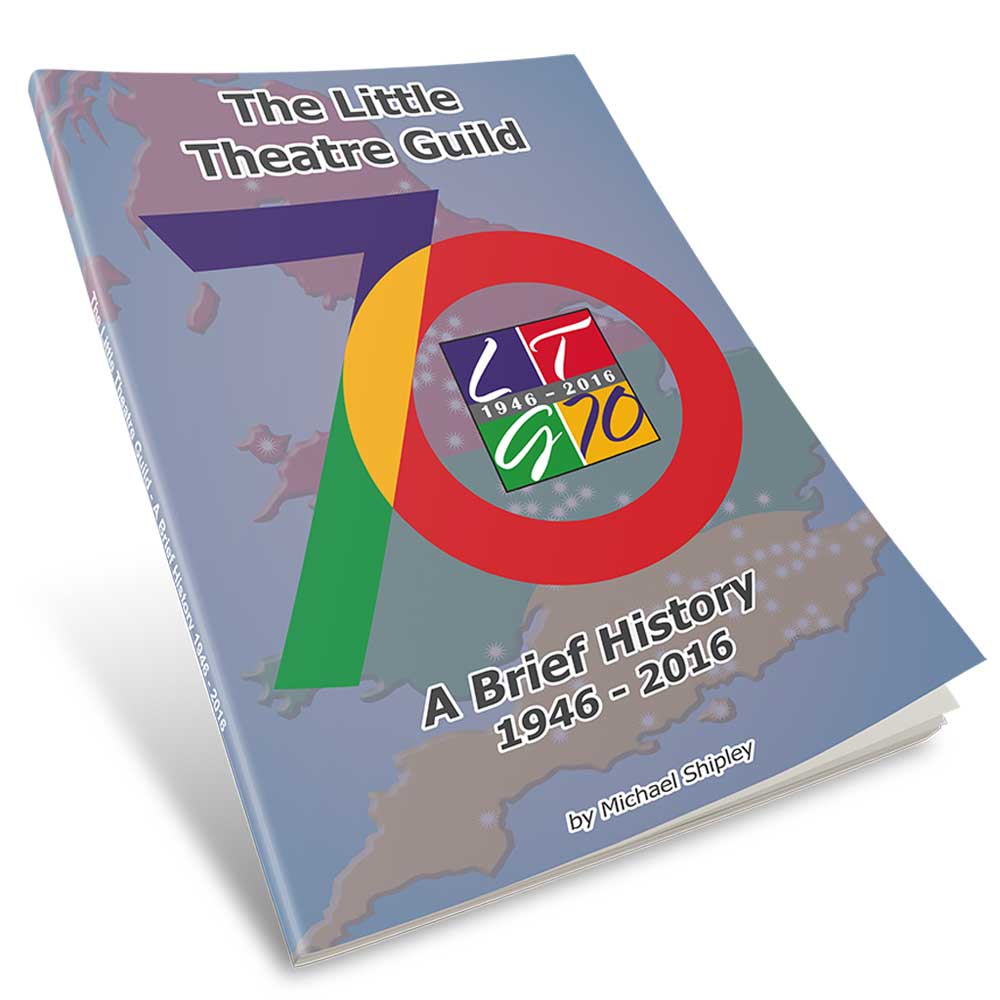
A wonderful potted history by Michael Shipley
When the National Committee decided to commission a history of the Little Theatre Guild to celebrate the 70th Anniversary, there was no one better qualified to perform this important task than Michael Shipley.
Download and enjoy the PDF.

